SMA RF Splitter
At home I have a small RTL-SDR (v4) sitting in the corner doing nothing. I wanted to connect it to an antenna, but making sure I don’t immediately break it when I transmit. Additionally, I have a new Icom IC-7300mk2 at home which has an RX-antenna function that allows you to route antenna signals outward to connect filters, before feeding the signal back in via the RX-IN to the receiver’s frontend.
What if we use this function not to connect a filter, but an RF splitter to hook up the RTL-SDR?
In the course you learn that when connecting in parallel, resistance goes down. The same applies when connecting multiple 50 ohm coax connections. To compensate for this, a small resistor network needs to be built to maintain proper impedance.
Example:
The schematic we’re going to build:
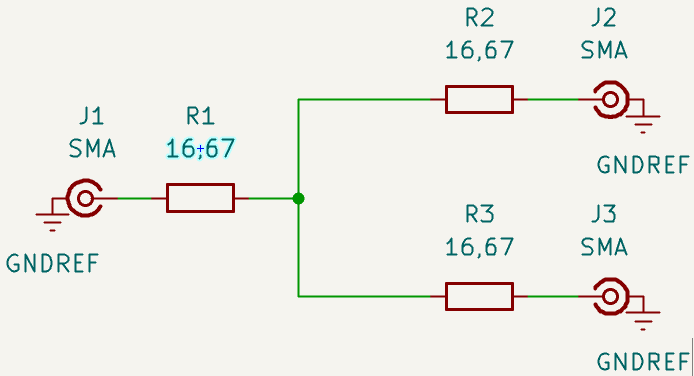
Due to the insertion of these resistors and the splitting of the signal, some loss is introduced. This amounts to approximately ~3dB from the split and ~3dB from the resistors. For RX this isn’t really a disaster. But you can compensate by placing a Low-Noise Amplifier in front of it with corresponding attenuation to arrive at a net 5-6dB gain before entering the circuit.
We want to amplify this signal before entering the splitter. Because trying to amplify the signal afterwards doesn’t work. What you’ve already lost doesn’t magically come back by amplifying the signal.
Quickly grabbed a small experimenter board from the drawer, 3 SMA connectors and some resistors. Within an hour everything was put together.
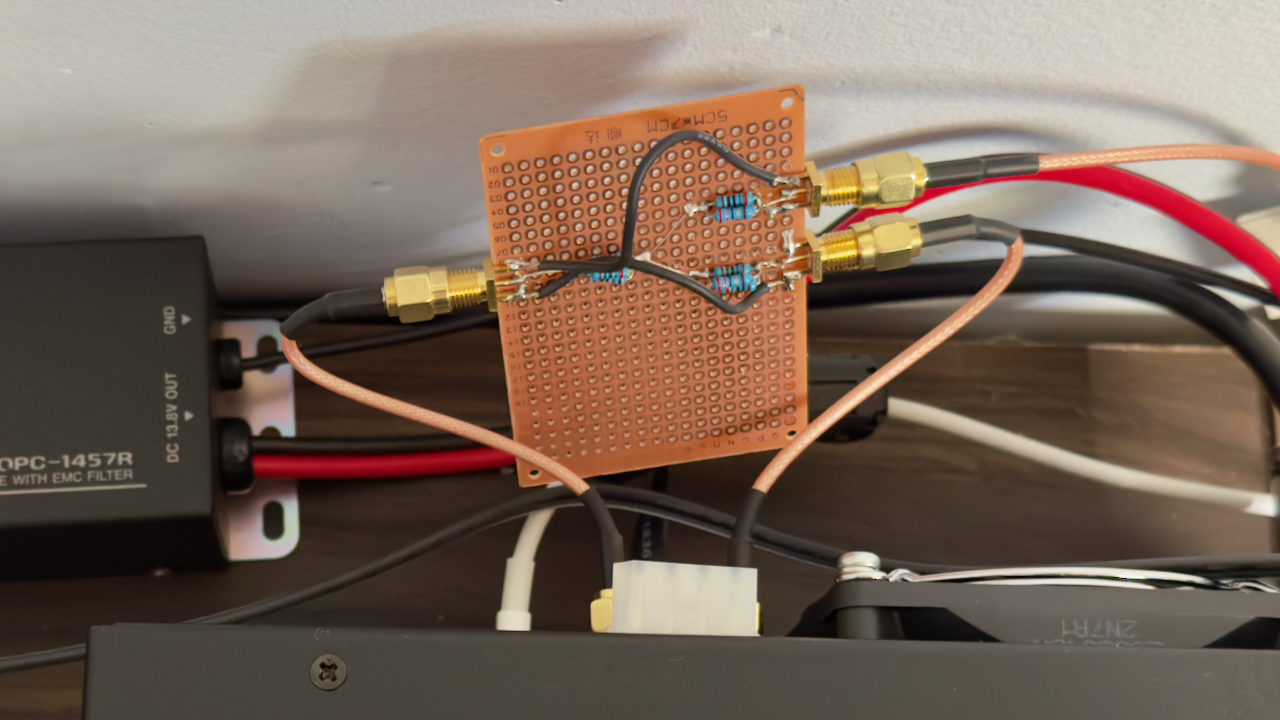
The result is quite decent. In the setup as shown in the image above, you can see a noticeable difference on the IC-7300mk2’s waterfall. This 6dB is noticeable. So adding an LNA is desirable. Now it turns out the LNA I have doesn’t deliver a clean 20dB, but about 30dB. Ultimately, to arrive at the same noise level, I need to put 23dB of attenuation after the LNA to come out at approximately net zero.
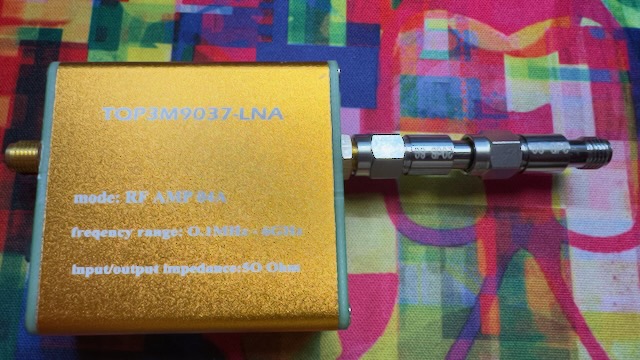
LNA with attenuators